Snake Plant Identification Guide
Identify the snake plant (Dracaena trifasciata, formerly Sansevieria) by its stiff, upright, banded sword-shaped leaves and rosette growth, and distinguish it from similar succulents.
Read the full Snake Plant encyclopedia entry →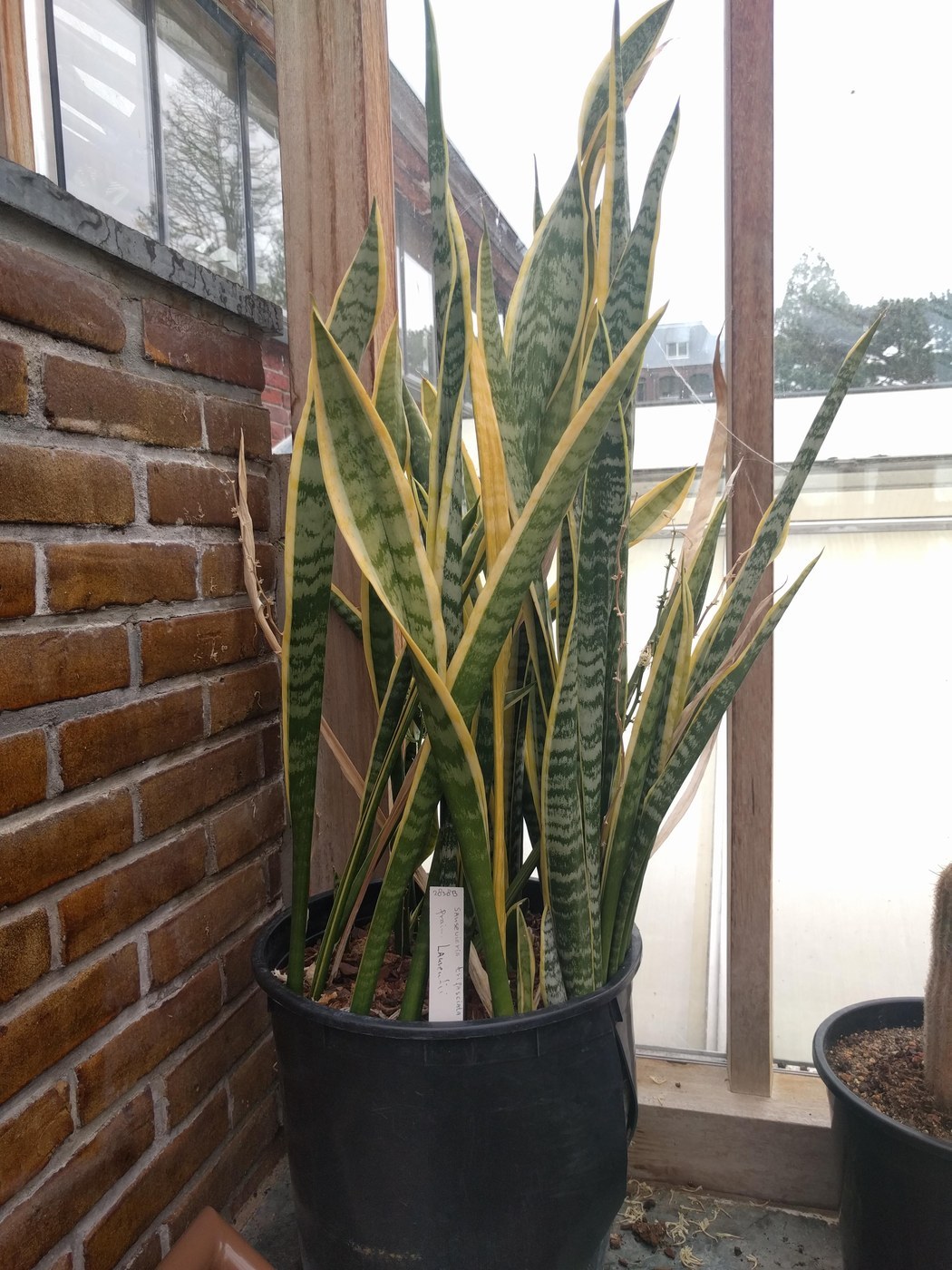
Key Identifying Features
The snake plant (Dracaena trifasciata, long known as Sansevieria trifasciata) is one of the easiest houseplants to identify:
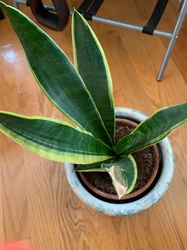
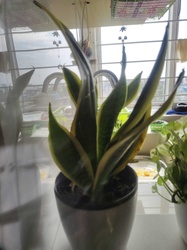
- Stiff, upright, sword-shaped leaves growing in a tight basal rosette directly from the soil.
- Leaves are thick, flat-to-slightly-concave, and rigid, with sharp pointed tips.
- A distinctive mottled, horizontal banding of light and dark green, like snakeskin.
Many cultivars add a yellow leaf margin (the popular 'Laurentii').
Leaves & Stems
There is essentially no visible above-ground stem — leaves rise straight from a thick underground rhizome. Leaves are succulent, leathery, and smooth, typically 30–120 cm (1–4 ft) tall depending on variety. Color is deep green with wavy gray-green cross-banding; variegated forms have creamy-yellow edges.
The leaf cross-section is firm and fibrous (the plant was historically grown for bowstring fiber). Cut a leaf and it stands on its own without wilting — a hallmark of its succulent, drought-storing nature. The dwarf 'Hahnii' forms a low bird's-nest rosette.
Flowers & Fruit
Flowering is occasional indoors. The plant sends up a tall, slender raceme of small, tubular, greenish-white flowers that are fragrant at night and produce sticky nectar droplets. Fruit (rarely seen in cultivation) is a small orange berry. Flowering is a pleasant surprise, not a reliable ID trait.
How to Tell It Apart from Look-Alikes
- Other Dracaena/Sansevieria species: Dracaena angolensis (formerly Sansevieria cylindrica) has round, cylindrical leaves, not flat ones. If the leaf is tube-shaped, it's the cylindrical snake plant.
- Agave: agaves form rosettes too, but leaves are usually broader at the base, often with marginal teeth or spines and a terminal spine; snake plant leaves are smooth-edged.
- Aloe: aloe leaves are thicker, more triangular in cross-section, contain gel, and often have soft marginal teeth; snake plant leaves are flatter, fibrous, and banded.
The clinching trait: flat, rigid, upright banded leaves from a rhizome with no leaf gel and no marginal spines.
Where You'll Find It
Native to tropical West Africa. Worldwide it's a top houseplant prized for tolerance of low light and neglect. In frost-free regions (USDA zones 9–11) it's used as a tough landscape groundcover and can spread to form colonies via rhizomes.
Quick ID Checklist
- Stiff, upright sword-shaped leaves in a rosette
- Horizontal snakeskin banding on the leaf face
- Often a yellow leaf margin (variegated forms)
- No visible stem; leaves emerge from soil/rhizome
- Leaves succulent and rigid, no spines, no gel
A tough, architectural plant with rigid banded sword-leaves rising straight up is almost certainly a snake plant.
Frequently asked questions
Is the snake plant a Sansevieria or a Dracaena?
Botanists reclassified Sansevieria into the genus Dracaena, so the correct current name is Dracaena trifasciata. Both names refer to the same plant, and Sansevieria is still widely used in the trade.
How do I tell a snake plant from an aloe?
Snake plant leaves are flat, rigid, fibrous, and banded with no internal gel and smooth edges. Aloe leaves are thicker, triangular in cross-section, filled with gel, and often have soft teeth along the margins.
Why does my snake plant have round leaves?
That's the cylindrical snake plant, Dracaena angolensis (formerly Sansevieria cylindrica), a close relative with tube-shaped leaves rather than the flat sword-shaped leaves of D. trifasciata.
Snake Plant identified by the community
Recent Snake Plant specimens identified with Plant Identifier.