Weeping Cherry Identification Guide
A practical guide to identifying weeping cherry trees (Prunus species) by their cascading branches, spring pink or white blossoms, and glossy bark.
Read the full Weeping Cherry encyclopedia entry →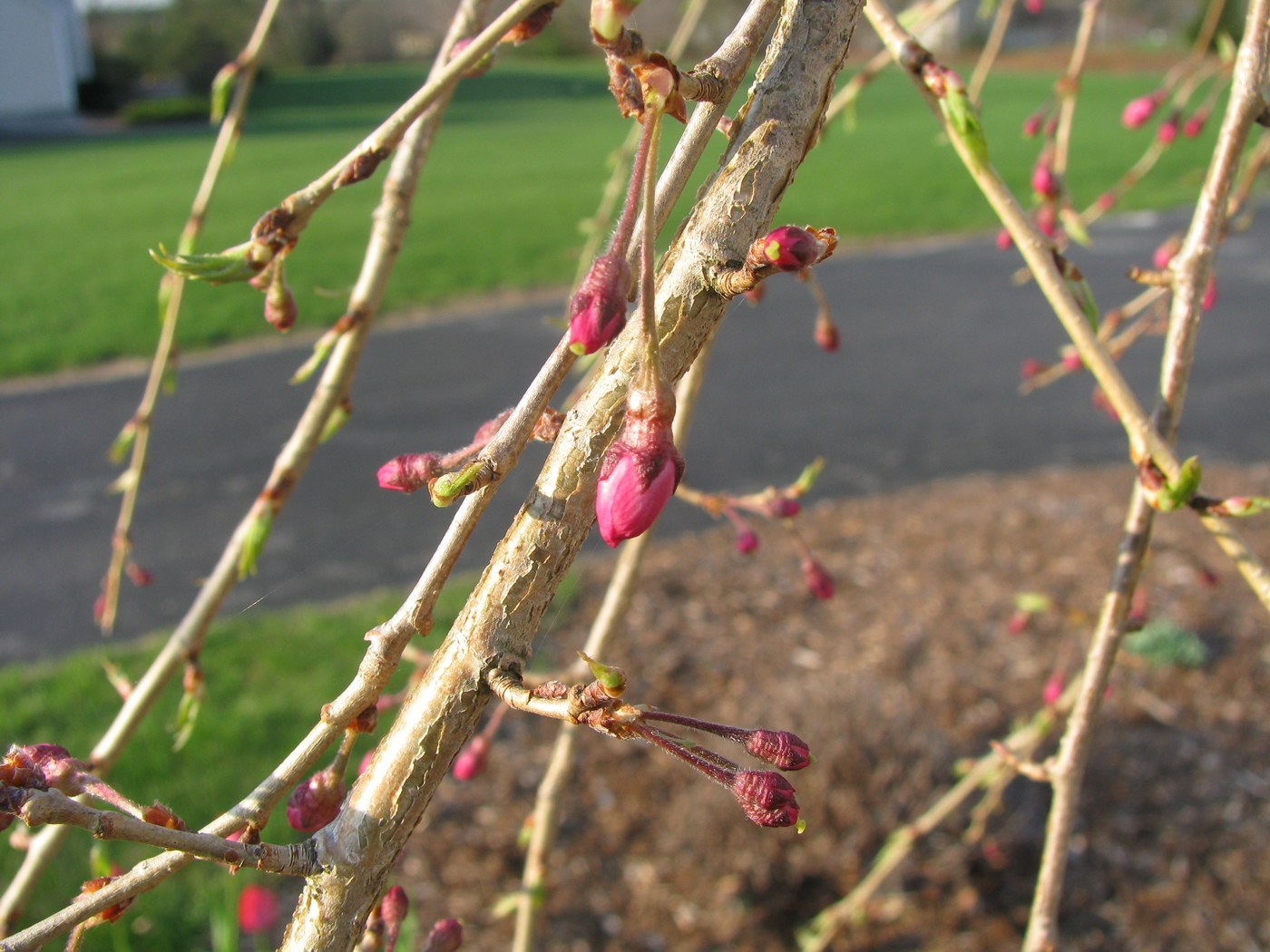
Key Identifying Features
Weeping cherry trees are ornamental flowering cherries (mostly Prunus pendula, Prunus subhirtella 'Pendula', and Prunus 'Snofozam'/Snow Fountains) recognized at a glance by their long, arching branches that hang straight down like a fountain. In early to mid spring they erupt in pink or white five-petaled blossoms before or as the leaves emerge.
- Pendulous, cascading branches often reaching the ground
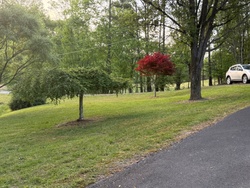
- Umbrella-shaped or dome-shaped canopy, frequently grafted at the top of a straight trunk
- Masses of single or double cherry blossoms in spring
- Smooth bark with horizontal lenticels typical of Prunus
Leaves & Stems
Leaves are alternate, simple, oval to lance-shaped, 2-4 in long, with finely serrated margins and a pointed tip. They emerge bronze-green, mature to medium green, and turn yellow to orange in fall. Slender twigs are reddish-brown and flexible, which is what allows the dramatic weeping habit. Many specimens are top-grafted: a straight rootstock trunk supports a weeping crown grafted at 4-6 ft, so the trunk itself is upright while everything above weeps.
Flowers & Fruit
Blossoms appear before or with the leaves, March-April depending on climate. Each flower has five petals (single forms) or many petals (double forms like 'Pink Cascade'), in shades from pure white to deep rose-pink, carried in clusters along the hanging branches. The base of each flower shows a small reddish calyx tube. Fruit, when it forms, is a tiny black to dark-red cherry; many ornamental cultivars set little or no fruit.
How to Tell It Apart from Look-Alikes
- Weeping willow: also cascades, but has long narrow strap-like leaves, no showy blossoms, and grows near water - very different leaf and no cherry bark.
- Upright flowering cherry (e.g. Yoshino, Kwanzan): same blossoms and bark but branches spread or ascend rather than hang down.
- Weeping crabapple: similar weeping shape and spring flowers, but produces small apple-like pomes (not cherries) and has duller bark without prominent horizontal lenticels.
- Weeping Higan cherry vs Snow Fountains: Higan tends pink and taller; Snow Fountains is compact and pure white.
The combination of horizontally-lined cherry bark, serrated oval leaves, five-petaled spring blossoms, and a curtain of hanging branches confirms a weeping cherry.
Where You'll Find It
It is a cultivated ornamental, planted as a lawn specimen, by entryways, near patios, and in parks and Japanese-style gardens. Hardy in USDA zones 4-8, it is common across temperate North America, Europe, and Japan.
Quick ID Checklist
- Branches arch and hang straight down, often to the ground
- Smooth bark with horizontal lenticels
- Five-petaled pink or white blossoms in early spring
- Alternate, serrated, oval-pointed leaves
- Often grafted atop a straight trunk
- Tiny dark cherries (or none) in summer
Frequently asked questions
How do I tell a weeping cherry from a weeping willow?
Look at the leaves and flowers. Weeping cherry has broad oval serrated leaves and showy pink or white spring blossoms with horizontally lined bark. Weeping willow has long, narrow strap-like leaves, no showy flowers, and typically grows beside water.
Why does my weeping cherry have a straight trunk but weeping top?
Most weeping cherries are top-grafted: a weeping variety is grafted onto a straight upright rootstock at about 4-6 feet. The trunk stays vertical while the grafted crown cascades.
What do weeping cherry leaves look like?
They are alternate, simple, oval to lance-shaped, 2 to 4 inches long, with finely serrated margins and a pointed tip. They emerge bronze-green, mature to medium green, and turn yellow to orange in fall.
When do weeping cherries bloom?
In early to mid spring, usually March to April, with the flowers opening before or as the leaves emerge. The bloom lasts roughly one to two weeks.
Weeping Cherry identified by the community
Recent Weeping Cherry specimens identified with Plant Identifier.