African Milk Tree Identification Guide
How to identify the African Milk Tree by its upright triangular ridged stems, paired thorns, and small teardrop leaves.
Read the full African Milk Tree encyclopedia entry →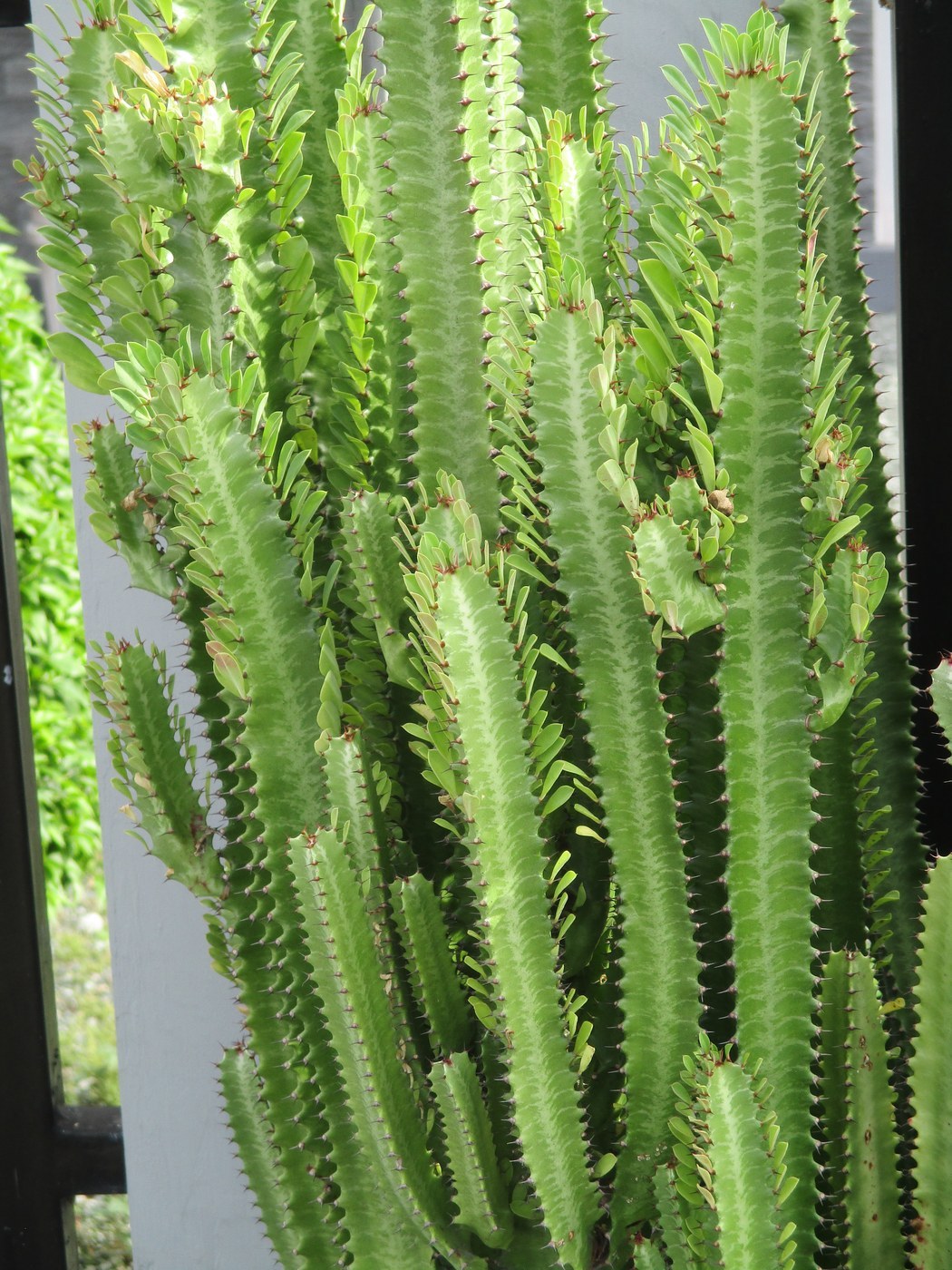
Key Identifying Features
The African Milk Tree (Euphorbia trigona) is a fast-growing, candelabra-like succulent that resembles a cactus but is a true Euphorbia.
- Upright, three- or four-sided (triangular) green stems
- Branches grow vertically, candelabra-style
- Paired thorns along the ridges
- Small, teardrop-shaped leaves sprouting from the ridges
Stems & Leaves
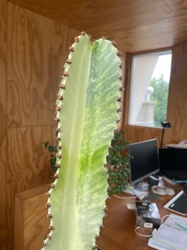
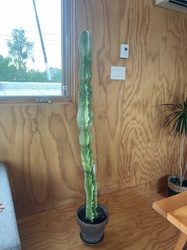
The stems are distinctly triangular or square in cross-section, with prominent winged ridges. Along each ridge run evenly spaced pairs of short, sharp brown thorns, and just above them sprout small, spoon- to teardrop-shaped green leaves that drop in dry or cool conditions. The plant branches upright from the main stems into a candelabra form, reaching 3–8 ft (1–2.5 m) indoors. A red-leaved cultivar (Euphorbia trigona 'Rubra'/'Royal Red') flushes maroon. Cut stems ooze a white milky latex — the trait behind the name and the surest way to separate it from true cacti.
Flowers & Fruit
Flowering is uncommon in cultivation; Euphorbia blooms are tiny and inconspicuous, lacking true petals. Most identification relies entirely on the stems, thorns, leaves, and milky sap rather than flowers.
How to Tell It Apart from Look-Alikes
- True cacti (e.g., columnar cacti): have areoles (spine cushions) and clear sap; Euphorbia has paired thorns from the ridge, leaves, and milky latex.
- Euphorbia ammak / Euphorbia ingens: larger tree euphorbias with similar form; trigona is smaller and leafier.
- African Milk Tree 'Rubra': same species, just red-tinted.
If an upright triangular "cactus" has small leaves and bleeds white sap, it's Euphorbia trigona, not a cactus.
Where You'll Find It
Thought to originate in Central Africa, it's grown worldwide as an easy, dramatic houseplant and, in frost-free climates, a landscape hedge. It wants bright light, warmth, and fast-draining soil, and is frost-tender.
Quick ID Checklist
- Upright triangular/3–4-sided ridged stems
- Candelabra branching habit
- Paired short thorns along the ridges
- Small teardrop leaves on the ridges
- Milky white sap when cut
- Sometimes red-flushed ('Rubra' cultivar)
Frequently asked questions
Is the African milk tree a cactus?
No. It's a Euphorbia. The giveaways are its paired thorns, small leaves, and milky white sap, none of which true cacti have.
Why are little leaves growing on my 'cactus'?
Those teardrop leaves are normal for Euphorbia trigona and confirm it isn't a cactus. They drop during drought or cold and regrow with warmth and water.
What's the red version called?
It's the cultivar 'Rubra' (also sold as 'Royal Red'), the same species with maroon-flushed stems and leaves in bright light.
African Milk Tree identified by the community
Recent African Milk Tree specimens identified with Plant Identifier.