Burdock Identification Guide
Identify burdock by its huge rhubarb-like basal leaves, thistle-like purple flowers, and the hooked burs that cling to clothing and fur. Covers look-alikes and habitat.
Read the full Burdock encyclopedia entry →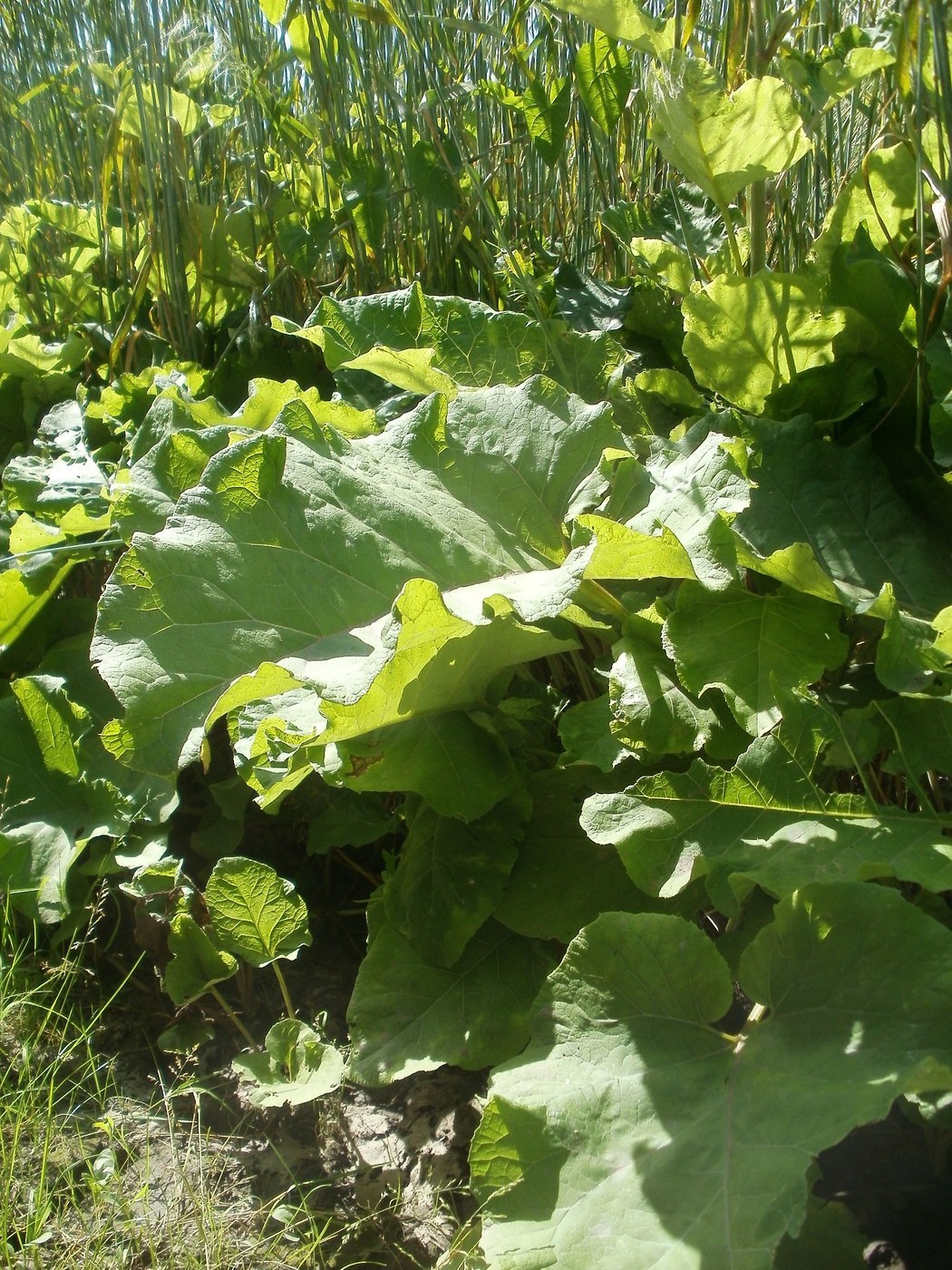
Key Identifying Features
Burdock (Arctium species, commonly A. minus and A. lappa) is a large biennial best known for its hooked burs that cling to clothing and animal fur — the natural model for Velcro. In its first year it forms a rosette of huge, heart-shaped, rhubarb-like leaves; in its second year it bolts a tall branched stalk topped with thistle-like purple flower heads that dry into the clinging burs.
- Very large, heart-shaped basal leaves (wavy-edged, woolly underneath)
- Stout taproot, biennial growth
- Purple thistle-like flowers surrounded by hooked bracts
- Hooked burs that stick to fur and clothes
Leaves & Stems
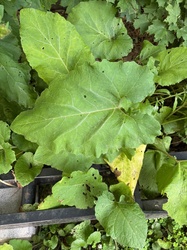
The first-year rosette leaves are enormous — up to 1 to 2 feet long — broadly heart-shaped (cordate), with wavy margins, dull green on top and whitish-woolly underneath, on hollow, often grooved leaf stalks. Second-year stems are stout, ridged, branched, and can reach 3 to 9 feet. Unlike true thistles, burdock leaves and stems are not spiny, only the flower bracts have hooks.
Flowers & Fruit
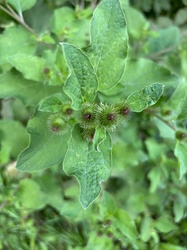
Flower heads appear in summer of the second year: round clusters of purple to pink tubular florets sitting atop a globe of green bracts, each bract ending in a tiny hooked tip. After flowering, the whole head dries to a brown bur covered in stiff hooks that latch onto anything brushing past — the most diagnostic and memorable feature of the plant. The burs carry the seeds far and wide.
How to Tell It Apart from Look-Alikes
- True thistles: Have spiny leaves and stems; burdock leaves are soft and spine-free, with hooks only on the flower bracts.
- Rhubarb: Has similar large leaves but red leaf stalks and no flower burs; rhubarb leaf stalks are flat-grooved and it does not form thistle-like flowers.
- Cocklebur: Also produces clinging burs, but its leaves are rough and triangular, not the large heart-shaped basal leaves of burdock.
Where You'll Find It
Burdock grows in disturbed, nutrient-rich ground: roadsides, pastures, ditches, fence rows, vacant lots, stream banks, and the edges of woods and fields across North America (introduced from Eurasia). It favors deep, moist soils and full to partial sun, often forming conspicuous large-leaved colonies.
Quick ID Checklist
- Huge heart-shaped leaves, woolly white underneath
- Soft, non-spiny leaves and stems
- Purple thistle-like flowers with hooked bracts
- Dry hooked burs that cling to clothing/fur
- Biennial; rosette first year, tall stalk second year
Giant rhubarb-like leaves plus clinging hooked burs make burdock easy to confirm.
Frequently asked questions
How is burdock different from a thistle?
True thistles have sharply spiny leaves and stems, while burdock has large, soft, spine-free heart-shaped leaves. Only burdock's flower bracts carry the hooks, which dry into the clinging burs.
Is burdock the inspiration for Velcro?
Yes. An engineer studied how burdock burs hooked onto his dog's fur and his clothing, and that hook-and-loop mechanism inspired the invention of Velcro.
Why is burdock a biennial?
It grows a leafy rosette and stores energy in its taproot during the first year, then in the second year it bolts a tall flowering stalk, sets seed in burs, and dies.
Burdock identified by the community
Recent Burdock specimens identified with Plant Identifier.