Butterfly Bush Identification Guide
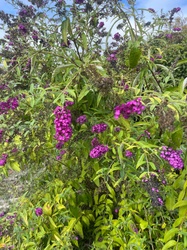
Identify Butterfly Bush (Buddleja davidii) by its arching stems, long lance-shaped opposite leaves with white-felted undersides, and fragrant cone-shaped flower spikes that draw butterflies.
Read the full Butterfly Bush encyclopedia entry →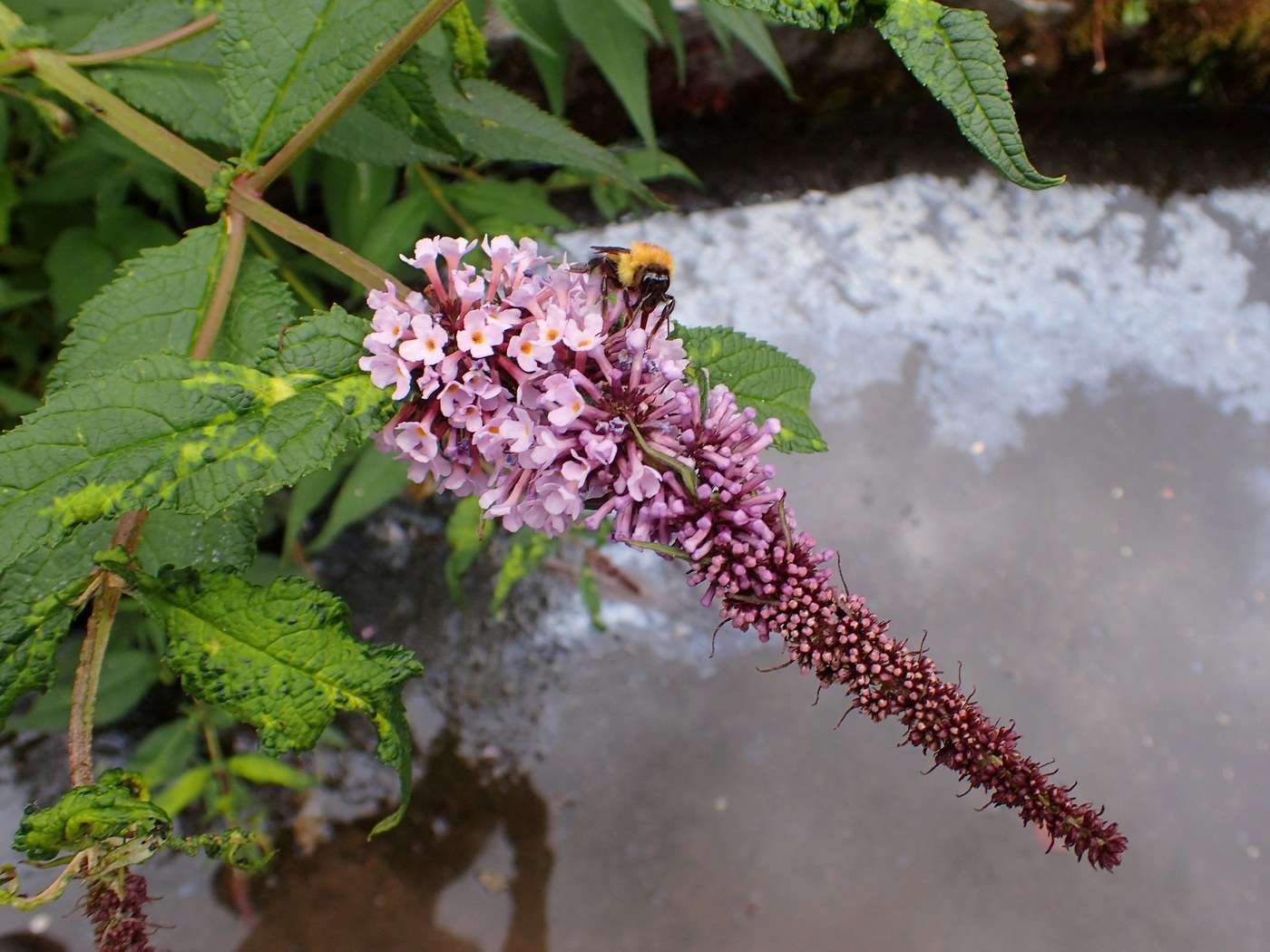
Key Identifying Features
Butterfly Bush (Buddleja davidii) is a fast-growing, arching deciduous shrub famous for long, fragrant flower spikes that attract butterflies. It is recognized by its drooping, tapering panicles, long narrow opposite leaves with woolly white undersides, and vigorous fountain-like form.
- Long, cone-shaped (conical) flower clusters at branch tips
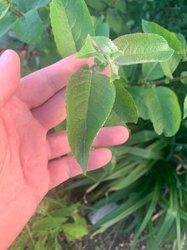
- Opposite, lance-shaped leaves, gray-green with white-felted undersides
- Arching, fast-growing stems forming a large mounded shrub
- Strong honey-like fragrance; butterflies and bees swarm it
Leaves & Stems
Leaves are opposite (paired), lance-shaped to narrowly elliptic, 4–10 inches long, with finely toothed margins. The upper surface is dull green while the underside is densely covered in white to gray woolly hairs — flip a leaf to confirm this key trait. Young stems are squarish and somewhat woolly, arching outward; the shrub regrows vigorously from the base and can reach 6–12 ft in a season.
Flowers & Fruit
Flowers are tiny, tubular, four-lobed, and packed into dense, tapering, cone-shaped panicles 4–12 inches long at the ends of arching shoots. Colors range from purple and lilac to pink, white, and magenta, almost always with a small orange eye at each flower's throat. They are sweetly fragrant and bloom summer into fall. Faded spikes produce masses of tiny seeds, and the plant self-seeds aggressively — it is invasive in many regions.
How to Tell It Apart from Look-Alikes
- Lilac (Syringa) also has cone-shaped flower clusters but blooms in spring, has heart-shaped smooth leaves, and lacks the white-woolly undersides.
- Vitex (chastetree) has palmately compound leaves, not simple ones.
- Summersweet (Clethra) has alternate leaves and upright white spikes.
- The combination of arching habit + long lance leaves with white-felted undersides + tapering fragrant flower cones with orange eyes confirms Butterfly Bush.
Where You'll Find It
Butterfly Bush is widely planted in temperate gardens worldwide for pollinators and is commonly naturalized along railways, roadsides, riverbanks, and waste ground, where it can become weedy. Native to China, it thrives in full sun and poor, well-drained soils.
Quick ID Checklist
- Arching, fast-growing shrub
- Opposite lance leaves, white-woolly beneath
- Long cone-shaped fragrant flower spikes
- Tiny tubular flowers with orange throat
- Butterflies/bees abundant; self-seeds freely
Frequently asked questions
What is the quickest way to confirm Butterfly Bush?
Flip a leaf over — the underside is densely white-woolly. Combined with arching stems and long tapering fragrant flower cones, that confirms Buddleja davidii.
How do I tell Butterfly Bush from lilac?
Lilac blooms in spring with heart-shaped smooth leaves, while Butterfly Bush blooms in summer-fall with narrow lance leaves that are white and woolly underneath.
Is Butterfly Bush invasive?
In many regions, yes. It self-seeds prolifically and naturalizes along roadsides and waterways, so some areas discourage planting it or recommend seedless cultivars.
Why do butterflies love it so much?
The dense clusters of small, nectar-rich, sweetly fragrant tubular flowers offer an easy landing platform and abundant nectar, drawing butterflies and bees in numbers.
Butterfly Bush identified by the community
Recent Butterfly Bush specimens identified with Plant Identifier.