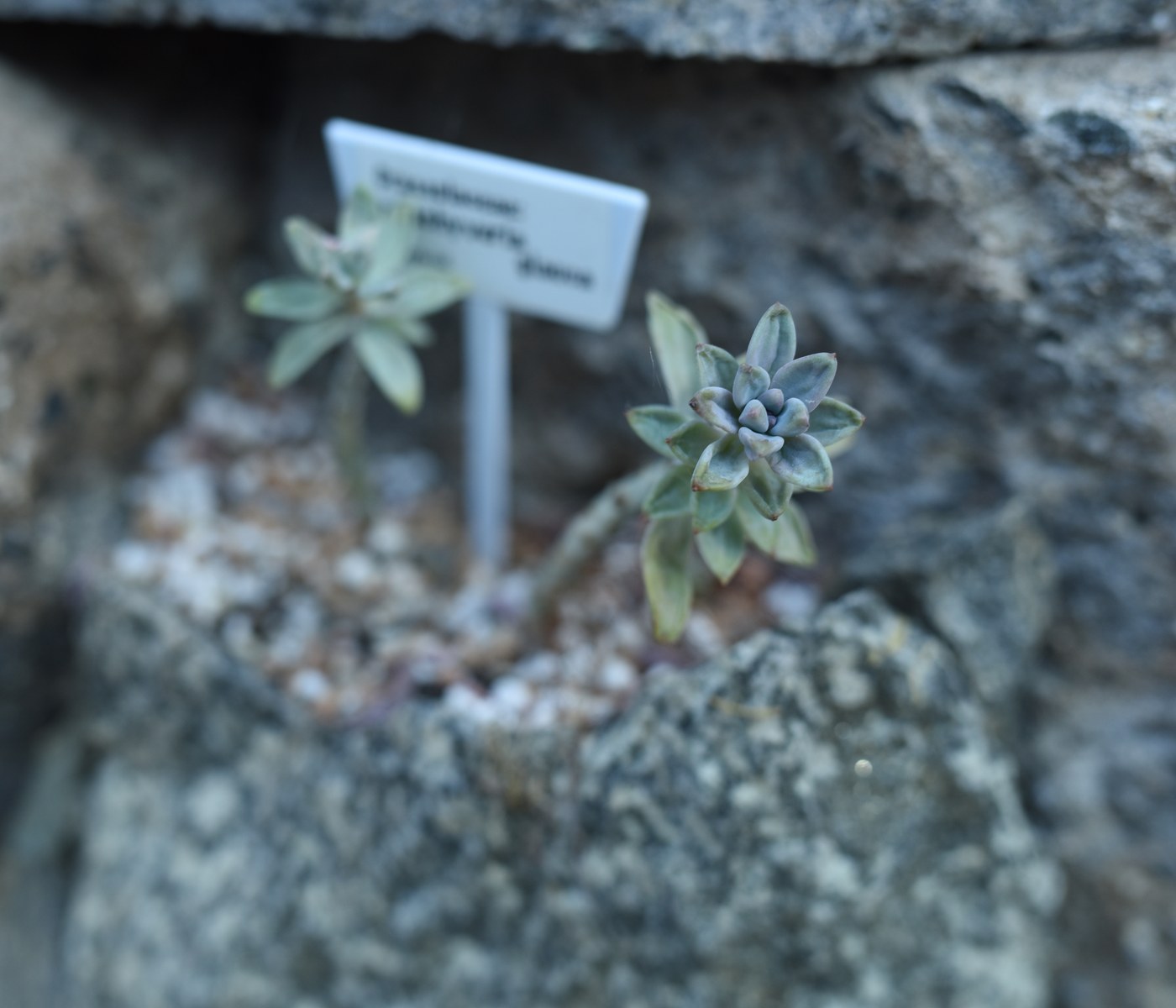
Little Jewel
Pachyveria glauca 'Little Jewel'
A compact intergeneric hybrid forming tight rosettes of plump, pointed, blue-green leaves tipped in rosy red. A small, jewel-like succulent that clusters into neat clumps.
- Light
- Full sun to bright indirect light
- Water
- Soak and dry fully between waterings
- Difficulty
- Easy
Got a plant like this?
Identify any plant from a photo, free.
Overview
Little Jewel is a Pachyveria — an intergeneric cross between Pachyphytum and Echeveria — grown for its small, dense rosettes of fat, pointed leaves. The blue-green, farina-dusted foliage takes on pink to red tips when grown in bright light.
It stays compact, typically only a few inches across, and readily produces offsets to form tidy clusters. Its small size and jewel-toned coloring make it ideal for dish gardens and miniature arrangements.
Like its parents, it is an easygoing, drought-tolerant succulent that asks mainly for sun and sharp drainage.
How to identify it
- Small, tight rosettes of plump, upward-curving, sharply pointed leaves
- Leaves are blue-green with a powdery bloom, flushing pink-red at the tips in sun
- Compact size, usually 2-4 in (5-10 cm) across, clustering into clumps of offsets
- Thick, water-storing leaves typical of its Pachyphytum and Echeveria parentage
- Arching stalks of bell-shaped flowers in shades of red-orange and yellow
Care & growing
Light: Full sun to bright indirect light; brighter light intensifies the rosy tips and keeps rosettes compact.
Water: Soak thoroughly, then let the soil dry out completely before watering again.
Soil: Gritty, fast-draining succulent mix.
Temperature: Warm, dry conditions preferred; protect from frost.
Feeding: Optional light feeding during the growing season.
Propagation: Easy from offsets, which can be separated and replanted, or from leaf and stem cuttings.
Habitat & origin
As a man-made hybrid, Little Jewel has no native habitat, but its parent genera Pachyphytum and Echeveria are native to Mexico, growing on rocky, sunny, well-drained slopes.
It is grown worldwide as a container and dish-garden plant in mild climates, and as an indoor succulent in bright light, thriving in the same warm, arid conditions favored by its parents.
Frequently asked questions
Why are the tips of my Little Jewel pink?
Bright light brings out rosy pink-to-red tips. This is healthy stress coloring; in low light the rosettes stay plain blue-green.
How do I propagate it?
Separate the offsets it produces around the base, or root individual leaves and stem cuttings after letting the cut ends callus.
Why are the lower leaves shriveling?
Some shriveling of the oldest bottom leaves is normal. Widespread shriveling usually means it's thirsty; a deep soak followed by full dry-out should restore plumpness.
Can it live indoors?
Yes, in your brightest window. Insufficient light causes stretching and loss of the compact, colorful form.
Little Jewel guides
In-depth guides for identifying, growing, and caring for Little Jewel.
How to Care for Little Jewel
Pachyveria 'Little Jewel' is a compact rosette succulent with powdery blue-green leaves. Easy, sun-loving, and forgiving with a soak-and-dry routine.
Little Jewel Identification Guide
Recognize Little Jewel (Pachyveria 'Little Jewel') by its compact rosette of plump, powdery blue-green leaves that blush pink-purple at the tips.