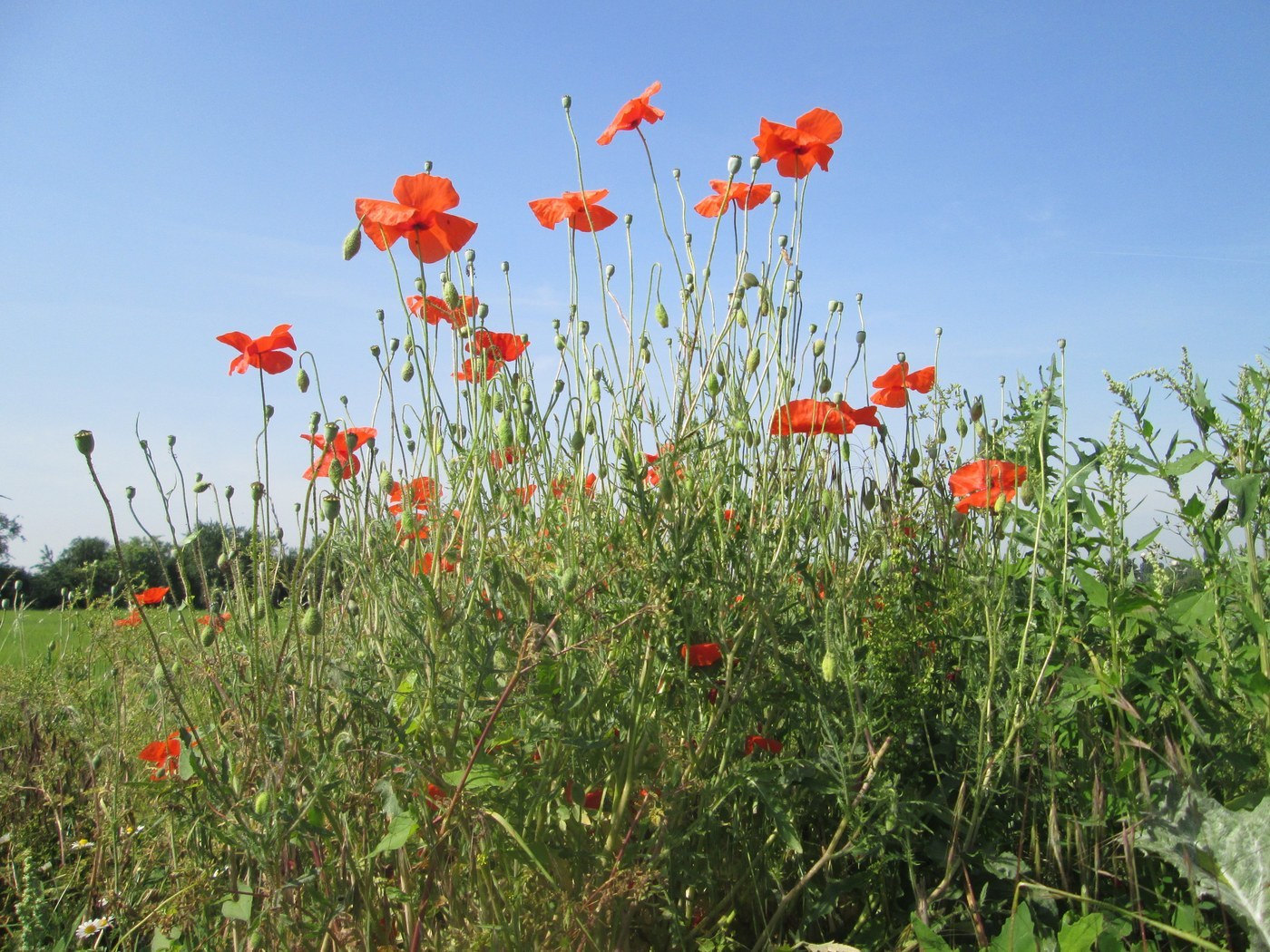
Corn Poppy
Papaver rhoeas
An annual wildflower famed for its papery, blood-red blooms that carpet European fields and serve as the international symbol of wartime remembrance.
- Light
- Full sun
- Water
- Low; drought tolerant once established
- Difficulty
- Easy
Got a plant like this?
Identify any plant from a photo, free.
Overview
The corn poppy is a fast-growing annual native to Europe, North Africa, and temperate Asia, where it has long colonized arable land, roadsides, and disturbed soil. Its delicate scarlet flowers and association with the WWI battlefields of Flanders made it an enduring emblem of remembrance.
Each plant produces a succession of single, four-petaled blooms over several weeks in early to midsummer. It self-seeds prolifically, making it a reliable choice for naturalistic meadow plantings and pollinator gardens.
How to identify it
Look for a slender, branching annual with bristly stems and finely divided leaves.
- Flowers: 5-10 cm wide, with four overlapping crinkled petals, usually vivid scarlet often with a dark blotch at the base
- Center: a ring of blue-black anthers around a flat-topped seed capsule
- Buds: nodding and hairy, opening to upward-facing blooms
- Leaves: light green, lobed and bristly-toothed
- Height: 30-90 cm with a slender, wiry habit
- Seed pod: smooth, rounded capsule that releases tiny seeds through pores
Care & growing
- Light: full sun is essential for strong flowering
- Water: minimal once established; tolerates dry conditions and dislikes soggy soil
- Soil: well-drained, even poor or disturbed ground; thrives in slightly alkaline soils
- Temperature: cool-season annual that germinates in cool weather and flowers before summer heat
- Feeding: generally unnecessary; rich soil produces foliage at the expense of flowers
- Propagation: sow seed directly where it is to grow in autumn or early spring; resents transplanting because of its taproot
Habitat & origin
Native across Europe, North Africa, and western and central Asia, the corn poppy is an archaeophyte that spread with early agriculture as a weed of cereal crops, hence the name.
It favors open, sunny sites with disturbed soil such as field margins, roadsides, and waste ground, and has naturalized widely in North America, Australia, and beyond. It is commonly grown in cottage gardens, wildflower meadows, and commemorative plantings.
Frequently asked questions
Is the corn poppy the same as the opium poppy?
No. The corn poppy (Papaver rhoeas) is a different species from the opium poppy (Papaver somniferum); the two differ in flower color and size and in the shape of their seed capsules.
Will corn poppies come back every year?
They are annuals, but they self-seed so generously that they often reappear in the same spot year after year as if perennial.
Why won't my poppies transplant well?
They form a delicate taproot that dislikes disturbance, so it is best to sow seed directly where they are to flower.
When should I sow corn poppy seed?
Sow in autumn or very early spring; the seed needs cool conditions and light to germinate, so press it onto the surface rather than burying it.
Corn Poppy guides
In-depth guides for identifying, growing, and caring for Corn Poppy.
How to Care for Corn Poppy
Sow Corn Poppy in full sun and lean soil for waves of silky scarlet blooms; this easy annual self-sows and thrives on neglect.
Corn Poppy Identification Guide
Learn to recognize the corn poppy by its papery scarlet petals, hairy stems, and finely divided leaves. This guide covers the features that separate it from other red poppies.