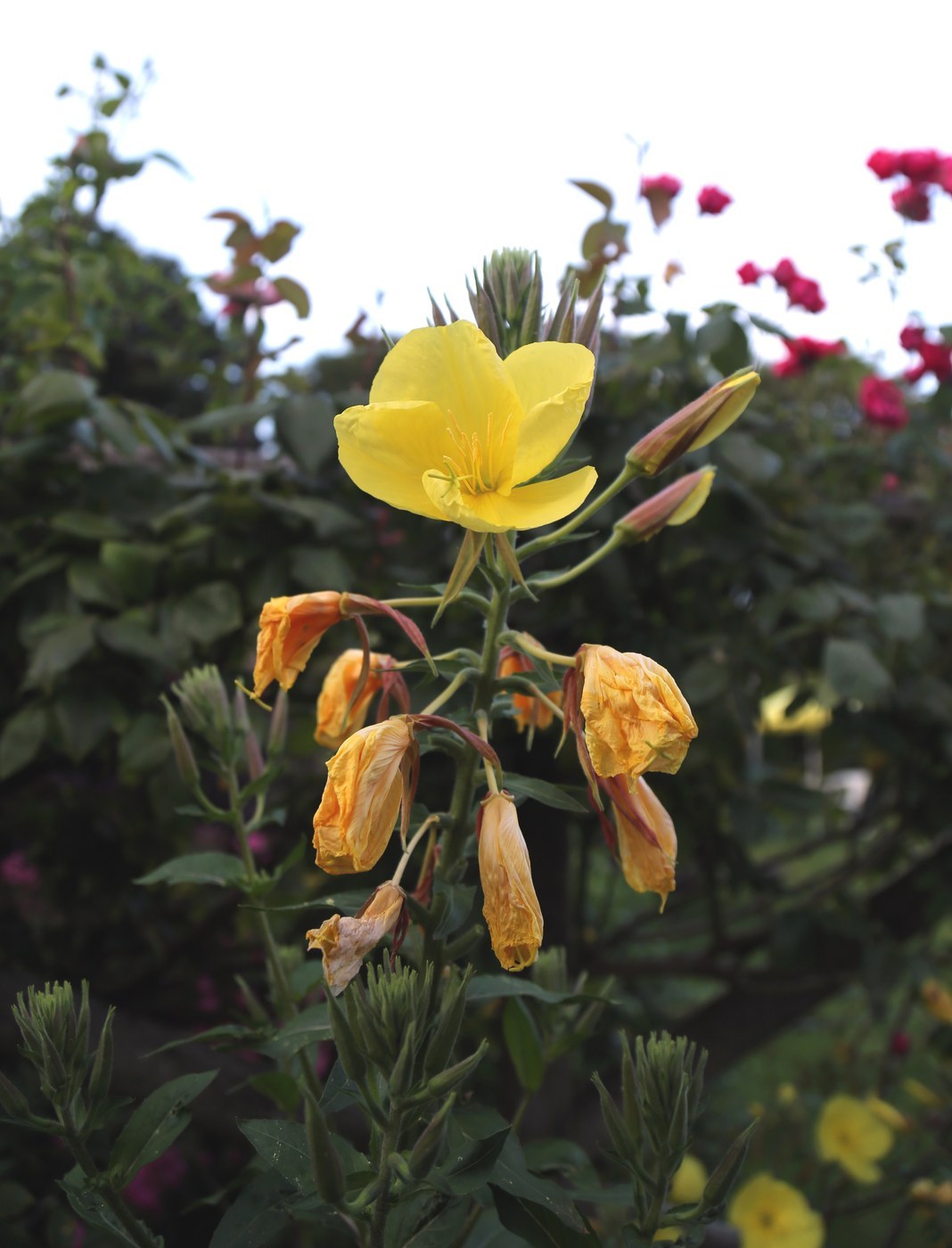
Evening Primrose
Oenothera biennis
A hardy biennial wildflower whose fragrant yellow blossoms open at dusk and close by midday, timed to attract night-flying moths. It forms a low rosette in its first year and a tall flowering stalk in its second.
- Light
- Full sun
- Water
- Low; drought tolerant
- Difficulty
- Easy
Got a plant like this?
Identify any plant from a photo, free.
Overview
Common evening primrose (Oenothera biennis) is a North American biennial named for its habit of opening its yellow flowers in the evening, sometimes visibly unfurling within minutes. The blooms release a lemony fragrance that draws pollinating moths after dark.
In its first year the plant forms a low rosette of leaves; in its second year it sends up a tall flowering stalk, sets seed, and dies. It self-sows freely and is often found on disturbed and poor soils.
Despite the name, it is unrelated to true primroses (Primula). Its seeds are held in upright, elongated capsules along the stem.
How to identify it
Look for a tall, leafy stalk topped with four-petaled yellow flowers that open in the evening.
- Flowers: Bright yellow, four heart-shaped petals, fragrant, opening at dusk and fading by the next midday
- Leaves: Lance-shaped, in a basal rosette the first year and alternate up the stem the second
- Stems: Erect, sometimes reddish and hairy
- Size: 3 to 5 feet (1 to 1.5 m) tall in flower
- Seeds: Held in upright, elongated capsules along the stem
Care & growing
Evening primrose is an undemanding, self-sufficient plant.
- Light: Full sun
- Water: Drought tolerant; tolerates dry, poor soils
- Soil: Prefers lean, well-drained, sandy or gravelly soil
- Temperature: Hardy biennial across a wide climate range
- Propagation: By seed; self-sows readily and can naturalize
- Note: Because it is biennial, allow some plants to set seed each year for continuity
Habitat & origin
Common evening primrose is native to eastern and central North America and has naturalized widely across Europe and other temperate regions.
It grows in open, sunny, disturbed habitats such as fields, roadsides, railway embankments, dunes, and waste ground, often pioneering poor or sandy soils.
Various Oenothera species and cultivars are grown in wildflower and pollinator gardens for their cheerful flowers and night fragrance.
Frequently asked questions
Why do the flowers open in the evening?
The blooms open at dusk and release a lemony fragrance to attract night-flying moths, their main pollinators, then close by the next midday.
Is evening primrose related to true primroses?
No. Despite the shared name, it belongs to the genus Oenothera and is unrelated to true primroses in the genus Primula.
Will evening primrose come back every year?
It is biennial, so individual plants live two years, but it self-sows freely and usually persists as a self-renewing patch.
How can I recognize evening primrose?
Look for a tall, leafy stalk 3 to 5 feet high topped with four-petaled yellow flowers that open at dusk, above a first-year rosette of lance-shaped leaves.
Evening Primrose guides
In-depth guides for identifying, growing, and caring for Evening Primrose.
How to Care for Evening Primrose
Growing guide for evening primrose (Oenothera biennis), a drought-tolerant biennial with fragrant yellow flowers that open at dusk.
Evening Primrose Identification Guide
Identify Evening Primrose (Oenothera) by its four-petaled yellow flowers that open at dusk and its distinctive cross-shaped stigma. This guide covers leaves, seed pods, and look-alikes.