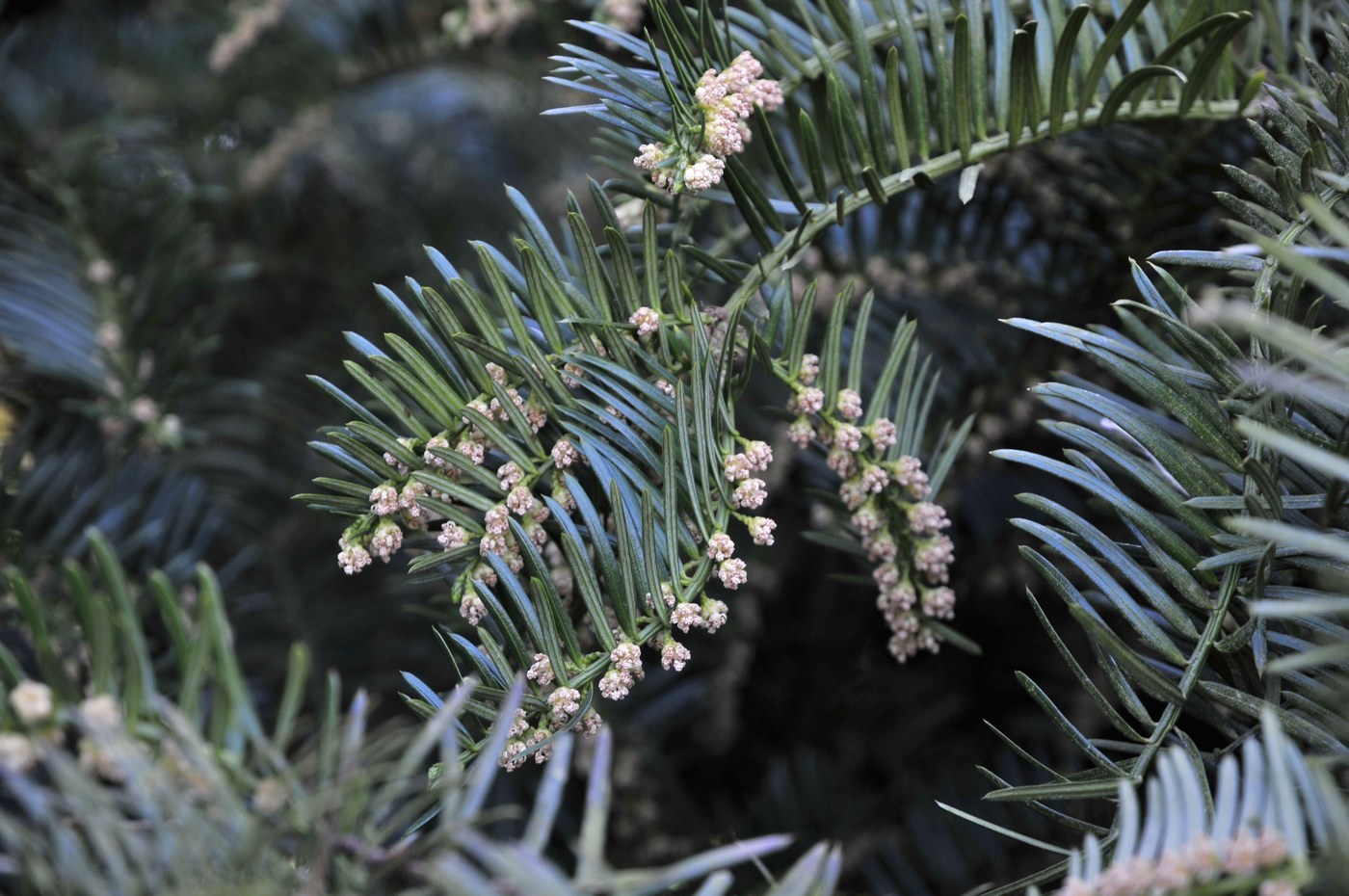
Plum Yew
Cephalotaxus harringtonii
Plum Yew is a shade-tolerant evergreen conifer resembling a yew but with longer needles and plum-like fleshy seed cones. It is valued as a tough, deer-resistant landscape shrub for shady gardens.
- Light
- Part shade to full shade
- Water
- Moist, well-drained soil
- Difficulty
- Easy
Got a plant like this?
Identify any plant from a photo, free.
Overview
Plum Yew (Cephalotaxus harringtonii) is an evergreen conifer native to Japan and eastern Asia, closely resembling a true yew (Taxus) but distinguished by its longer needles and large, olive- or plum-like fleshy seed coverings.
Unusually shade- and heat-tolerant for a conifer, and notably deer-resistant, it has become a popular landscape shrub, especially in the southeastern United States where true yews struggle.
How to identify it
- Needles: Linear, 2-5 cm, dark glossy green with two pale bands beneath, softer and longer than yew, arranged in two ranks; spreading in a 'cow's tail' fashion in some cultivars
- Seeds: Olive- to plum-shaped fleshy green seeds 2-3 cm, ripening purplish-brown (plants are usually dioecious)
- Habit: Spreading to upright evergreen shrub or small tree, 2-5 m; cultivars range from prostrate ('Prostrata') to columnar ('Fastigiata')
- It looks like a coarse-needled yew but with much larger, plum-like seeds
Care & growing
Light: Tolerates full shade to part shade better than most conifers; also takes sun in cooler climates.
Water: Prefers moist, well-drained soil; reasonably drought-tolerant once established.
Soil: Adaptable, fertile, well-drained soil; tolerates clay and a range of pH.
Temperature: Hardy to USDA zone 6-7; notably heat- and humidity-tolerant.
Feeding: Light spring feeding optional.
Propagation: From semi-hardwood cuttings (the usual method for cultivars) or seed.
Habitat & origin
Native to Japan and parts of eastern China and Korea, where it grows as an understory shrub in shady, humid woodlands and on mountain slopes.
Its shade tolerance makes it a natural understory plant, and in cultivation it is widely used in shady, deer-prone, and hot-humid gardens across temperate Asia, Europe, and the United States.
Frequently asked questions
How is plum yew different from true yew?
It has longer, softer needles and large fleshy plum-shaped seeds, and it tolerates heat and humidity far better than true yews.
Is plum yew deer-resistant?
Yes, it is one of the more reliably deer-resistant conifers, a major reason for its landscape popularity.
Can it grow in shade?
Yes. It is unusually shade-tolerant and performs well even in deep shade where many conifers fail.
Plum Yew guides
In-depth guides for identifying, growing, and caring for Plum Yew.
How to Care for Plum Yew
Grow-care guide for Plum Yew (Cephalotaxus harringtonii): a shade-tolerant evergreen shrub with soft needles, easy in moist, well-drained soil.
Plum Yew Identification Guide
How to identify plum yew (Cephalotaxus) by its long, spine-tipped, soft needles in two ranks and large plum-like olive-green seeds. Covers needles, fruit, habit, and how to separate it from true yew.